
Preserve Today. Protect Tomorrow.
Placenta Banking-Nature's Source for Regenerative Medicine.
Placenta banking preserves powerful stem cells, growth factors, and healing tissues that are being studied for their potential to help treat a wide range of conditions for generations to come.

ONE BIRTH. MULTIPLE BENEFITS.
Preserve all that nature provides.
Preserve
A rich source of stem cells and growth factors
Support
Future advances in regenerative medicine
Protect
What matters most with a simple, one-time collection
100% Natural
Safe, painless & non-invasive
What Is Placenta Banking?
Placenta banking preserves the tissue of the placenta-a powerful source of mesenchymal stem cells (MSCs), growth factors, and other bioactive compounds that support healing, regeneration, and immune balance.
What is stored:
Mesenchymal Stem Cells (MSCs)
Support tissue repair and regeneration
Placental Epithelial Cells
Important for wound healing
Immune-Modulating Cells
May help regulate inflammation & immune response
Growth Factors & Cytokines
Naturally occurring compounds that support healing
Why Placenta?
- Larger source of stem cells than cord tissue
- Multiple cell types with complementary benefits
- Rich in growth factors and healing proteins
- Rapid cell proliferation in research studies
- Strong anti-inflammatory and immunomodulatory properties
- Collected safely and naturally-painless for mom and baby
Placenta vs Cord Blood vs Cord Tissue
Swipe to compare
| Feature | Cord Blood | Cord Tissue | Placenta |
|---|---|---|---|
| Main Cell Type | Hematopoietic Stem Cells | Mesenchymal Stem Cells | Mesenchymal Stem Cells + additional placental cells |
| FDA-Accepted Transplant Use | Yes | No | No |
| Used for Blood Diseases | Yes | No | No |
| Stem Cell Transplant for Leukemia | Yes | No | No |
| Regenerative Medicine Potential | 3 out of 5 | 4 out of 5 | 5 out of 5 |
| Cell Quantity | Limited | Good | Largest Source |
| Additional Growth Factors | Limited | Limited | Extensive |
| Tissue Repair Applications | Limited | Research | Extensive Research |
Staging note: every row in this comparison, including the FDA row, the regenerative-medicine ratings and the cell-quantity wording, is pending scientific, regulatory and legal review and is not approved for publication.
Why Placental Amnion MSCs Stand Out
Multiple studies suggest that amnion-derived MSCs may have distinct biological advantages compared with cord tissue MSCs.
1. Proliferate Faster & Expand More
- Divide more rapidly in culture.
- Can be expanded into much larger numbers.
- Maintain stem cell characteristics longer with less cellular aging.
Result: More therapeutic cells may be produced for treatment.
2. Secrete More Growth Factors
Amnion MSCs may produce higher levels of regenerative factors.
VEGFHGFEGFTGF-βIGFIL-10PDGFFGFThese factors help support tissue repair, reduce inflammation, and recruit the body’s own healing cells.
3. Stronger Immune Regulation
- May more effectively suppress excessive immune responses.
- Lower immunogenicity.
- Potential relevance for immune-related conditions.
Especially promising for GvHD, autoimmune diseases, chronic inflammation, and more.
4. More Primitive (“Younger”) Cells
- Develop early in pregnancy.
- Express more primitive stem cell markers.
- May have greater differentiation potential.
- Lower senescence (cell aging).
Amnion MSCs are biologically “younger” and may be more versatile.
5. Better Support for Hematopoietic Stem Cells (HSCs)
Comparative research has found that placental MSCs may increase the number of functional HSCs more effectively than cord tissue MSCs.
- Better direct cell-to-cell support.
- A more favorable growth factor and cytokine profile.
- May help preserve HSC “stemness.”
This may have future clinical relevance for improving cord blood therapies.
6. Amnion Membrane Has Established Clinical Uses
The amniotic membrane, a natural biological scaffold, has been used clinically for decades.
- Anti-inflammatory.
- Anti-scarring.
- Antimicrobial.
- Low immunogenicity.
Used in wound healing, burns, oral surgery, plastic surgery, ophthalmic procedures, and orthopedic applications.
Comparing Placental Amnion MSCs vs. Cord Tissue MSCs
| Feature | Placental Amnion MSCs | Cord Tissue MSCs |
|---|---|---|
| Cell Yield & Expansion | Higher proliferation rate and greater expansion potential. | Good expansion, but generally lower than amnion MSCs. |
| Growth Factor Secretion | Higher levels of multiple growth factors and cytokines. | Lower overall secretion levels. |
| Immune Modulation | Stronger immunosuppressive and anti-inflammatory effects. | Moderate immunomodulatory effects. |
| Cell “Youthfulness” | More primitive, lower senescence, and potentially greater differentiation capacity. | More mature, with higher senescence over time. |
| Support for HSCs | May be more effective at expanding and maintaining HSCs. | May be less effective at supporting HSC expansion. |
| Best-Known Strengths | Immune regulation, growth factor secretion, HSC support, wound healing, and tissue regeneration. | Musculoskeletal repair, cartilage regeneration, bone and tendon healing, and neurological research. |
Key Takeaway
Complementary, Not Competitive.
Together, cord blood, cord tissue, and placental tissue offer broader therapeutic potential for today and tomorrow.
Already Used in Medicine Today
Wound Care
Helps treat diabetic foot ulcers, burns, surgical wounds, and chronic non-healing wounds.
Eye Surgery
Amniotic membrane grafts are used for corneal injuries, dry eye, and ocular surface repair.
Orthopedics
Being investigated for tendon injuries, joint inflammation, and sports medicine.
Investigational Applications Under Study
- Neurological Disorders
- Autoimmune Diseases
- Heart Repair
- Diabetes Type 1
- Liver & Kidney Disease
- Stroke Recovery
- Spinal Cord Injury
- Osteoarthritis & Joint Repair
- Crohn’s Disease
- And More
These applications remain investigational and are not established treatments for banked placenta tissue.
Conditions Being Researched in Clinical Trials Using Placental Cells
Placental-derived cells—rich in mesenchymal stem cells (MSCs), trophoblast cells, growth factors, and cytokines—are being studied for their potential to repair tissue, support regeneration, and modulate immune activity across a wide range of conditions.
Autoimmune Diseases
- Systemic lupus erythematosus (SLE)
- Rheumatoid arthritis (RA)
- Multiple sclerosis (MS)
- Type 1 diabetes
- Psoriasis
- Inflammatory bowel disease, including Crohn’s disease and ulcerative colitis
Immune & Inflammatory Disorders
- Graft-versus-host disease (GvHD)
- Cytokine release syndrome (CRS)
- Severe allergic or atopic diseases
- Chronic inflammatory conditions
Neurological Disorders
- Cerebral palsy
- Autism spectrum disorder (ASD)
- Alzheimer’s disease
- Parkinson’s disease
- Spinal cord injury
- Stroke
Orthopedic & Musculoskeletal Conditions
- Osteoarthritis of the knee, hip, and hand
- Cartilage repair
- Tendon and ligament injuries
- Degenerative disc disease
- Bone regeneration and fracture healing
Cardiovascular Diseases
- Ischemic heart disease
- Heart failure
- Myocardial infarction (heart attack)
- Peripheral artery disease
- Pulmonary hypertension
Gynecological Conditions
- Asherman’s syndrome
- Premature ovarian insufficiency (POI)
- Endometriosis
- Polycystic ovary syndrome (PCOS)
- Uterine fibroids
- Recurrent pregnancy loss
Respiratory Diseases
- Bronchopulmonary dysplasia (BPD)
- Asthma
- Chronic obstructive pulmonary disease (COPD)
- Pulmonary fibrosis
Liver Diseases
- Liver cirrhosis
- Non-alcoholic fatty liver disease (NAFLD/NASH)
- Acute liver failure
Wound Healing & Tissue Repair
- Chronic non-healing wounds
- Diabetic foot ulcers
- Burn injuries
- Skin regeneration
- Corneal healing
Ocular Diseases
- Corneal damage and ulcers
- Dry eye disease
- Retinal degenerative diseases
- Optic nerve injury
Blood & Hematologic Conditions
- Anemia
- Thalassemia
- Sickle cell disease
- Leukopenia
Other Conditions Under Investigation
- Chronic kidney disease
- Pancreatic disorders
- Sepsis
- Anti-aging and longevity applications
Why Preserve All Three at Birth?
Each source provides unique cells and bioactive factors—together, they may unlock broader future potential in regenerative medicine.
Cord Blood
Hematopoietic Stem Cells (HSCs)
Rebuilds the blood and immune system.
Cord Tissue
Mesenchymal Stem Cells (MSCs) from Wharton’s jelly
Supports research into musculoskeletal, neurological, and organ repair.
Placental Tissue
Amnion & Chorion
Contains distinct MSCs, epithelial cells, growth factors, cytokines, and extracellular matrix.
The Broadest Future Potential
For your family—today, tomorrow, and in the years ahead.
Placenta and umbilical cord science overview
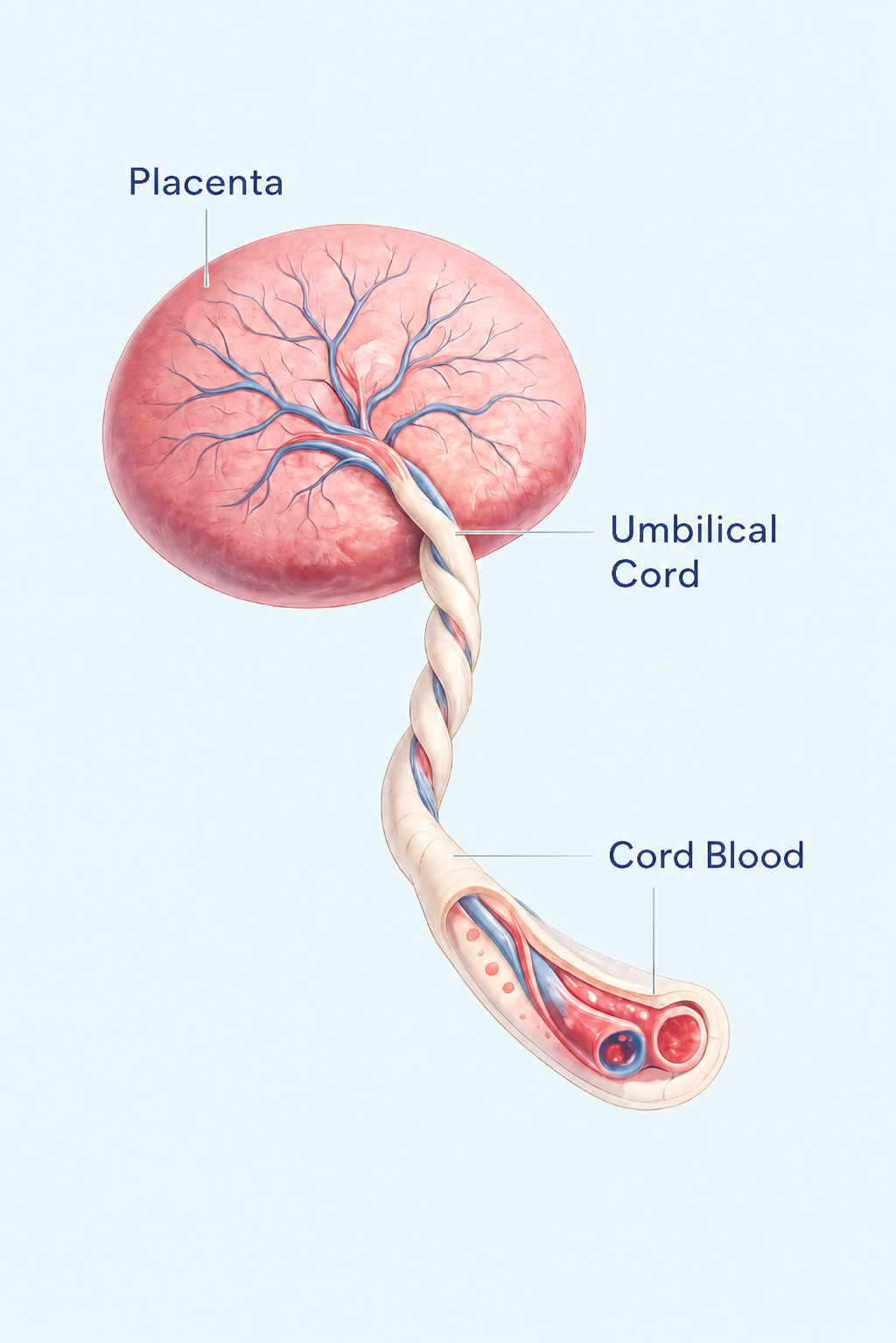
Placenta
Rich source of cells, growth factors and healing matrix.
Umbilical Cord
Found in the vessels and tissue in Wharton’s jelly.
Cord Blood
Hematopoietic stem cells that can rebuild blood and immune systems.
Key motivations for parents
Maximize stem-cell “insurance”
From a single birth-especially with a family history of blood, autoimmune, or degenerative diseases.
Interest in regenerative applications
Anti-inflammatory and regenerative areas studied for placenta-derived cells: wound healing, orthopedics, neurological, autoimmune.
Public inventories may have limited matches
For people of color or mixed-race families-private banking preserves your baby’s cells and tissues.
Placental MSCs are “younger”
And show strong immunomodulatory and regenerative capabilities in preclinical studies.
Complementary tissues
Together, these tissues may offer future therapies that use multiple cell types in combination.
What placenta tissue can do
focus of research
Rich in diverse cells
Hematopoietic stem cells, mesenchymal stem/stromal cells (MSCs), and other progenitors from multiple regions of the placenta.
Anti-inflammatory & immunomodulatory
Secretes cytokines and growth factors that down-regulate inflammation and modulate immune cell behavior.
Pro-healing extracellular matrix
Collagen-rich scaffolds with glycosaminoglycans and proteins that support tissue repair, new blood vessel growth, and reduced scarring.
Relative immune privilege
Placental tissues have immunologic properties being studied for potential allogeneic applications.
Large & growing body of evidence
Extensive preclinical research and early clinical studies across many therapeutic areas.
Applications being studied (research and clinical uses)
Applications being studied
Wound Care & Surgery
Amniotic and chorionic membranes are used clinically for chronic wounds, burns, ocular surface reconstruction, and surgical repair.
Orthopedic & Musculoskeletal
Placenta-derived MSCs are investigated for cartilage, bone, tendon, and ligament repair.
Neurological & Neurodegenerative
Preclinical studies suggest neuroprotective interest in stroke, spinal cord injury, and neurodegeneration.
Autoimmune & Inflammatory
Explored in trials and animal models for GvHD and other immune-mediated conditions.
Cardiovascular & Other Tissues
Early research explores potential applications in heart injury, lung disease, skin regeneration, and other tissues.
These are areas of research and existing clinical use of specific placental products. They do not describe treatments currently available using privately banked placenta tissue.
Continuous Research, Innovation and Clinical Advancement
The growing field explores the development and composition of each placental tissue, focusing on the structural and signaling components relevant to medical applications. It also highlights current configurations and recent innovations in the use of placental tissues as biomaterials in regenerative medicine.